An aerobic septic system costs $10,000 to $20,000 installed according to HomeAdvisor (June 2026) and This Old House (March 2026, Angi data); Fixr (January 2025) lists $10,000 to $20,000 too, but in a materials-only table. HomeGuide puts an aerobic treatment unit (ATU) much higher, at $20,000 to $40,000 or more. The price covers the treatment unit with its air pump, usually a disinfection step, and the field or spray area after it. Then comes the part people underestimate: an ATU needs servicing for as long as it runs, and some states require a paid maintenance contract.
Aerobic system cost by source
| Guide | Aerobic system, installed | Conventional system, same guide |
|---|---|---|
| HomeAdvisor (Jun 20, 2026) | $10,000–$20,000 | $3,000–$8,000 |
| This Old House (Mar 12, 2026; Angi data) | $10,000–$20,000 | $3,000–$8,000 |
| Fixr (Jan 31, 2025), table marked materials only | $10,000–$20,000 | $2,000–$10,000 |
| HomeGuide (Sep 22, 2025 system guide; same range in its Dec 2025 engineered-system guide) | $20,000–$40,000+ | $3,500–$8,500 |
HomeGuide’s two septic guides agree with each other on $20,000 to $40,000 or more. HomeGuide files ATUs under engineered systems that pump effluent to the field, but neither it nor the other guides says what its total includes, so the gap of about double stays unexplained. Fixr also prices a related job: turning an existing anaerobic system into an aerobic one costs $5,000 to $10,000 in its guide.
How an aerobic unit works
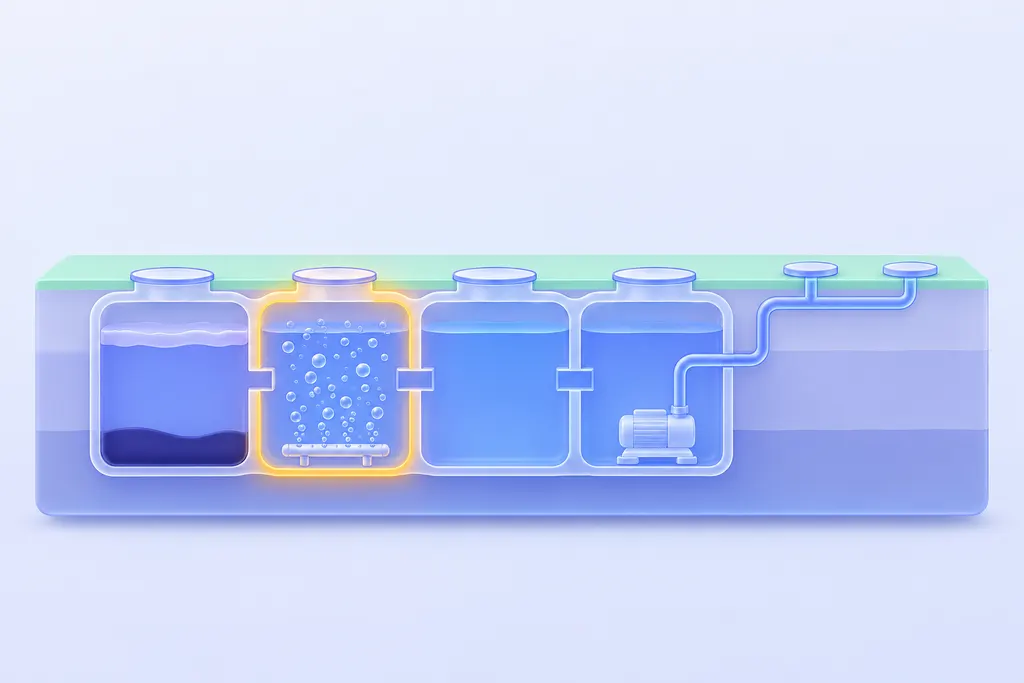
The EPA compares an ATU to a municipal treatment plant on a small scale: oxygen pumped into the tank feeds bacteria that break the waste down further. Texas A&M AgriLife Extension describes four working parts:
- a pretreatment (“trash”) tank that catches what bacteria can’t digest;
- an aeration chamber, where an air pump and diffusers bubble air through the wastewater;
- a clarifier, where spent bacteria settle out;
- a final treatment and dispersal step that returns the water to the soil.
Texas A&M credits these units with stripping 85 to 98 percent of organic matter and solids from the wastewater. In Texas, the water usually goes to a spray field after a disinfection unit. HomeGuide notes that disinfection may use chlorine or UV light.
When a lot calls for one
The EPA lists the sites ATUs suit: small lots, poor soil, a high water table, or a home near a lake or stream that’s sensitive to nutrients. HomeGuide says their cleaner output often makes them the preferred design in environmentally sensitive areas.
You don’t choose one on your own, though. The site evaluation and your county or state health department decide which designs a lot may use; see perc test and septic system types compared. On shallow soil, the other common answer is a mound septic system.
What raises the bill
HomeGuide’s notes on engineered systems point to four cost drivers (only the first is specific to ATUs):
- Power. The aerator needs an electrical connection, which adds installation work and a running cost every month.
- Permits. Engineered systems often need extra permits, electrical ones included; HomeGuide puts permits and inspections at $500 to $2,000.
- Design and testing. Engineering and design typically run $1,000 to $3,000, and a perc test $200 to $1,500 or more.
- Labor. 50 to 70 percent of the total, for crews who handle pumps, wiring and specialized dispersal.
A conventional bid broken into lines is on septic system installation cost.
NSF/ANSI 40 and 245
These are the testing standards behind the unit’s listing. Florida’s rule 62-6.012 requires units treating up to 1,500 gallons a day to be listed by an approved third-party program and to meet at least one of three standards: NSF/ANSI 40 (Class I residential treatment), NSF/ANSI 245 (nitrogen reduction) or NSF/ANSI 350 (water reuse). In Texas, Texas A&M says units sold as Class I must pass testing under NSF Standard 40.
In practice, ask which standard the model you’re quoted meets and whether your county requires 245 because of nearby water.
Service contracts and upkeep
The EPA puts systems with pumps or moving parts on a roughly yearly inspection schedule and recommends a service contract for them, and HomeGuide says an ATU should be inspected at least once a year. Two states write the contract into law:
- Texas (30 TAC §285.7). A two-year service policy starts when the system is first used, and the owner files a signed copy with the permitting authority before approval. After that, a single-family owner either maintains the system personally or signs a new contract. TCEQ says the contract should name the licensed provider, what’s covered, response times, and how often maintenance, testing and reporting happen.
- Florida (Rule 62-6.012). A current maintenance contract is a condition of approval: at least two years at first, then renewals of at least one year for the life of the system.
Texas A&M’s upkeep list includes pumping the trash tank about every 2 to 3 years, keeping the air pump running with a clean intake filter, keeping power on, and maintaining spray heads. If an alarm goes off, it says to call your maintenance provider and cut nonessential water use; see septic alarm going off.
Units with chlorinators need tablets kept stocked. Texas A&M warns that chlorine gas can burn your lungs, and TCEQ says swimming pool tablets must never go in a wastewater chlorinator because they can release an explosive gas. Leave refills to the provider if you’re unsure.
None of the cost guides checked prices a yearly ATU service contract, so ask for that number in writing before you sign.
Aerobic vs. conventional
Air is pumped into the treatment tank, so the water leaving it is much cleaner.
- $10,000–$20,000 (HomeAdvisor, This Old House; Fixr as materials only); $20,000–$40,000+ (HomeGuide).
- Smaller field after the unit, HomeAdvisor says.
- Needs constant power for the aerator (Texas A&M AgriLife).
- Inspected about once a year (EPA); a service contract is required at first in Texas and for life in Florida.
- Struggles in homes used only on weekends, since the bacteria need a steady supply of waste.
Gravity sends settled effluent from the tank into a gravel or chamber drain field.
- $3,000–$8,000 (HomeAdvisor, This Old House); $3,500–$8,500 (HomeGuide).
- Needs a larger field and deeper, well-draining soil.
- No added power or chemicals, This Old House notes.
- Inspected at least every three years (EPA).
- Only allowed where the site evaluation finds suitable soil.
Questions to ask before you sign
- Which make and model are you installing, and which NSF/ANSI standard does it meet?
- Does the price include the trash tank, pump tank, disinfection unit, wiring and the spray or drip field?
- What does the first service contract cover, how long does it run, and what does renewal cost?
- How often will the provider visit, and who files the reports the county wants?
- Who refills the chlorinator, and which tablets does this unit take?
- Are design, perc test and permit fees in this bid?
- Are you licensed to install aerobic units in this state, and will the contract list the full scope?
Common questions
What are the disadvantages of an aerobic septic system?
It costs more to install than a conventional system, it draws power around the clock, and it needs regular servicing for as long as it runs, which the EPA describes as life-time maintenance. Texas A&M AgriLife adds that a neglected unit may not clean the water as well as intended, and that homes used only part of the time struggle to keep the bacteria alive.
How long does an aerobic septic system last?
For advanced treatment units the EPA says to ask the manufacturer about expected life; the pumps and controls around them commonly last 10 to 20 years by its estimate. HomeGuide says engineered systems can last 15 to 40 years or more when maintained.
Do aerobic septic systems need electricity?
Yes. Texas A&M AgriLife says the aeration system needs a continuous power supply because the aerobic bacteria depend on the air it delivers. If the aerator stops or an alarm sounds, Texas A&M says to call your maintenance provider and cut nonessential water use.
Can I maintain my own aerobic septic system?
It depends on where you live. In Texas, the owner of a single-family home may take over after the initial two-year service policy, but TCEQ notes that some local authorities require training first or don't allow it. Florida requires a maintenance contract for the life of the system. Ask your county or local health department.
Are aerobic septic systems required in Texas?
Not for every home. The design comes from the site evaluation and the local permitting authority. Texas A&M AgriLife notes that aerobic units are the usual way to treat wastewater before a spray field, so they are common where soil can't take a conventional field. Once installed, Texas rules require a two-year service policy.
Want the numbers for your own house? The planner sizes the tank for your bedrooms, estimates the pump-out interval for your household and lines up dated price ranges.
Open the plannerPictures on SepticSizer are schematic drawings produced with an AI image tool. None of them is a photo of a real tank, yard, crew, product or job.
Sources
12 citedHide listShow all 12
- HomeAdvisor (opens in a new tab) How Much Does a Septic System Cost in 2026? Updated Jun 20, 2026Checked Nov 25, 2026
- This Old House (opens in a new tab) How Much Does a Septic Tank Installation Cost? Updated Mar 12, 2026Checked Nov 24, 2026 prices from Angi
- Fixr (opens in a new tab) How much does it cost to install a septic tank system? Updated Jan 31, 2025Checked Nov 24, 2026
- HomeGuide (opens in a new tab) How Much Does an Engineered Septic System Cost? Dec 22, 2025Checked Nov 25, 2026
- HomeGuide (opens in a new tab) How Much Does a Septic Tank System Cost? Sep 22, 2025Read Nov 24, 2026 in the Internet Archive copy of Oct 5, 2026
- U.S. EPA (opens in a new tab) How to Care for Your Septic System Last updated Aug 17, 2026Checked Nov 24, 2026
- U.S. EPA (opens in a new tab) Frequent Questions on Septic Systems Last updated Mar 11, 2026Checked Nov 24, 2026
- Texas A&M AgriLife Extension (opens in a new tab) L-5302, Aerobic Treatment Unit, PDF pp. 1–4 Revised Sep 2008Checked Nov 24, 2026
- Texas Administrative Code (opens in a new tab) 30 TAC §285.7, Maintenance Requirements Amended effective Jul 6, 2023Checked Nov 24, 2026 Cornell LII
- Texas Commission on Environmental Quality (opens in a new tab) Maintenance of On-Site Sewage Facilities Last modified Mar 3, 2026Checked Nov 24, 2026
- Florida Administrative Code (opens in a new tab) Rule 62-6.012, Aerobic Treatment Units Amended effective Jun 21, 2022Checked Nov 24, 2026 Cornell LII
Prices are national ranges as each guide published them, on the date shown. Rules and fees differ by state and county, so confirm with your local health department.